Empty Reflection
You Should Have LeftThe empty reflection is the mountain house’s most persistent visual contradiction. In the window, the narrator can see the room and its contents with unsettling clarity, but not the person sitting before the glass. The anomaly makes the reflection more than a distorted image: it becomes a test of whether the room, the observer, and the surrounding reality still belong to the same physical order.
Definition and First Appearance
The phenomenon first occurs against the otherwise recognizable interior of the living room. The room has a parquet floor, white walls, flat ceiling lamps, a large stainless-steel kitchen with a central island, and a wooden table facing a huge glass window. From there, the narrator watches Susanna and Esther build heaps of stones in the meadow while their breath forms small clouds in the darkening afternoon. The scene appears stable and legible, and the glass seems to confirm that stability by returning the narrator’s glasses, hair, collar, notebook, and pen.
That apparent reassurance is immediately weakened by the reflection’s uncertainty. The narrator sees himself as though placed on a stage, but the image is described as translucent, and the thought that the entire disturbance was only imagination remains available as a retreat. The reflection therefore introduces the anomaly without yet proving it. It is both an image of presence and a warning that presence may no longer be guaranteed.
The Sustained Anomaly
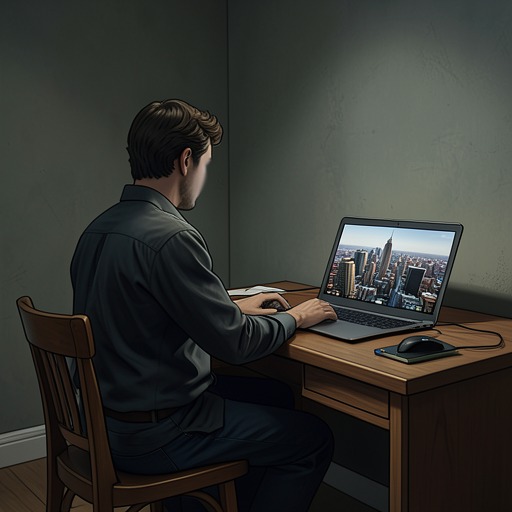
The phenomenon becomes undeniable when the narrator sits at the long table in the mountain house as evening approaches. The window reflects the refrigerator, stove, kitchen table, hall door, flat-screen television, low gray-green sofa, lamp, table, chair, a crumpled grocery bag, and an empty glass. Everything that should make the reflected room recognizable is present. Only the narrator is absent.
The omission is not a simple failure to reflect the body. The narrator notices that the handle of the living-room door should be hidden because the narrator is sitting between the door and the windowpane. Yet the handle is visible. So are the back of the chair, the tabletop, and the open notebook on which the narrator is writing. Covering the notebook with a hand does not remove it from the reflected scene. The reflected room is not merely missing one image; it appears to be an unoccupied version of the room in which the narrator is visibly acting.
The duration of the event changes its meaning. An earlier absence had lasted only a moment, allowing it to be dismissed as a mistake of attention. This time the reflection continues. The narrator records that it is still happening, then watches it persist. The effort to write everything down becomes an attempt to preserve an event that memory is already threatening to dissolve.
Return, Doubt, and Recurrence
The anomaly stops only when the narrator stands up to look for a phone and briefly looks away. On turning back, the narrator is once again in the room and the reflection imitates the narrator’s movement. The notebook records both sides of the event: the narrator sits and writes, while the reflected figure also sits and writes. Yet the restoration does not restore certainty. Almost immediately, the narrator feels as though the event happened long ago and anticipates no longer knowing whether it was real. Even the written record cannot fully defeat the suspicion that the experience was imagination.
The empty reflection returns under more dangerous conditions. After a fall on the stairs, the narrator looks toward the window and sees the reflection apparently corrected: the narrator and Esther are visible. But the living-room door is wide open even though the narrator had locked it. The image therefore remains anomalous even when the missing body reappears. The central disturbance has shifted from absence alone to a mismatch between the reflected arrangement and the room’s remembered physical state.
Near the end, rain draws lines down the window, making the room visible in the reflection once again. The long table, cabinet, kitchen, and door can all be seen, but no one occupies the reflected room. A notebook lies on the table. The recurring image closes on that object, linking the empty reflection to the narrator’s effort to document events and leaving the record itself inside the uncanny duplicate of the house.
Relation to Objects, Measurement, and Escape
The reflection is part of a wider collapse of the narrator’s ordinary methods of verification. Driving is already experienced as a dangerous passage from everyday routine to catastrophe, and the descent to Gruntner’s General Store becomes a sequence of hairpin bends, braking, reversing, sweat, blinding sunlight, and repeated attempts to keep away from the unguarded edge. After the shop visit, the return drive is calmer and reveals details previously missed: a pile of stones beside the ruined barn, a rusted tractor, birds exploding from a bush, and an orange cloud. The familiar route thus changes according to the narrator’s mental state, just as the window changes according to the narrator’s position and attention.
At the house, external tools are recruited to stabilize reality. The narrator writes in a notebook, searches the garbage for the crumpled bill from Gruntner’s General Store, uses the stamped address and telephone number to call for a taxi, and raises the phone in search of a network signal. These supports fail in different ways: the telephone rings for a long time before the shopkeeper answers, the connection later shows no network, and the house’s doors lead back into the living room. The notebook preserves observations, but the narrator still fears that the observations will be reclassified as imagination.
The triangle ruler offers an especially concrete parallel. The narrator draws right angles and bisectors, expecting measurement to settle what perception cannot. A right angle measures ninety degrees, yet its two parts measure forty and forty-two, leaving several degrees apparently unaccounted for. In another construction, the corresponding angles measure forty-nine and fifty-one. The figures remain geometrically complete while their parts refuse consistent measurement. Like the empty reflection, they preserve the outward form of an ordinary world while violating the relations that make that world intelligible.
Narrative and Thematic Significance
The empty reflection defamiliarizes the most automatic of visual assumptions: that a reflective surface returns the observer’s body and that a room has one stable arrangement. Furniture and appliances remain dependable enough to be catalogued, but the subject who performs the cataloguing disappears. This reversal makes the familiar interior strange without requiring a new setting; the house becomes frightening precisely because it continues to look like a house.
The image also exposes a divided relation between perception and self-recognition. The narrator repeatedly sees evidence, records it, measures it, and then withdraws into the possibility of error. The reflection’s absent body literalizes that instability: the observer is present as consciousness and action, yet absent from the visual world that should confirm the observer’s existence. The notebook, the ruler, the phone, the locked door, and the reflected window all become external instruments of certainty, but each either contradicts the narrator or proves unable to hold reality in place.
Its final recurrence prevents a reassuring explanation. The room reflected in the rainy window is empty, but the notebook remains, as if testimony can survive where the witness cannot. The image consequently joins the mountain house’s spatial distortions, failed exits, and repeated returns. It is not only a supernatural effect or a symptom of confusion; it is the book’s clearest form for a world in which objects retain their appearance while identity, position, and continuity quietly detach from them.